
Running two or three gig jobs at once sounds like a smart way to boost your earnings, but the moment tax time arrives, the cracks start to show. Between Uber trips, Menulog deliveries, and the odd PAYG shift, your income is scattered across platforms, bank accounts, and apps that never quite talk to each other. One missed receipt or an incorrectly categorised payment can mean a costly ATO audit or a missed deduction worth hundreds of dollars. This guide walks you through every step, from understanding what you owe to building a system that keeps you compliant and in control all year round.
Table of Contents
- Understanding your gig income types and tax obligations
- Setting up your records and tools
- Step-by-step: Tracking income and expenses from every gig
- Maximising deductions and complying with GST rules
- Preparing for tax time: Filing, ATO data-matching and audit-proofing
- Why smart systems beat last-minute scrambles every time
- Make gig income tracking effortless with GST Driver Tracker
- Frequently asked questions
Key Takeaways
| Point | Details |
|---|---|
| All gig income is taxable | You must report income from every rideshare or delivery platform on your Australian tax return. |
| Use the right tools | ATO-compliant apps and separate bank accounts make tracking multiple income streams much simpler. |
| Good records deter audits | Keeping detailed, separate, and accurate records is your best defence against ATO reviews and penalties. |
| Logbook method boosts claims | A proper 12-week logbook can mean higher car deductions than per-kilometre rates for most active drivers. |
Understanding your gig income types and tax obligations
Many drivers struggle right from the start: what category does each job fall into, and what does the ATO actually see?
The first thing to sort out is the difference between PAYG employment and ABN-based gig work. If you pick up a casual warehouse shift and receive a payslip with tax already withheld, that income goes in the employment section of your tax return. But every dollar you earn through a rideshare or delivery platform, whether it is Uber, DiDi, Menulog, or DoorDash, is treated as business income. These earnings must be declared using the Business and professional items schedule, and the ATO requires all gig income to be reported regardless of the amount earned, even if you only drove for a few weekends.
Here is what makes this particularly important: the ATO does not rely on you to volunteer the information. Platforms are required to report your earnings directly to the tax office through data-matching programmes. So if you earned $4,200 from Menulog and forgot to include it, the ATO already knows. Multiple income streams under an ABN must be classified correctly, with platform earnings from Uber, Menulog, and similar services placed in the Small Business Schedule, while PAYG income sits separately in the employment section.
| Income type | Platform examples | Where to report | GST applies? |
|---|---|---|---|
| Rideshare | Uber, DiDi, Ola | Business and professional items schedule | Yes, from day one |
| Food delivery | Menulog, DoorDash | Business and professional items schedule | Only if turnover exceeds $75,000 |
| PAYG casual work | Warehouse, hospitality | Employment income section | No |
| Freelance/contractor | Various | Business and professional items schedule | Depends on turnover |
The consequences of getting this wrong are real. Undeclared income triggers ATO data-matching flags, which can lead to amended assessments, interest charges, and penalties. Staying across your income tracking basics from the start is far less painful than untangling a mess at year's end.
ATO reminder: All gig platform income must be declared as business income in your tax return, no matter how small the amount. The ATO cross-checks platform reports against individual returns every year.
Setting up your records and tools
Once you know what you need to track and declare, it is about getting the right setup so you do not get lost in paperwork or app overwhelm.
The ATO requires you to keep records for five years. This includes platform payment statements, receipts for vehicle expenses, fuel logs, insurance documents, and bank records. Primary records, meaning original documents rather than reconstructed estimates, are what the ATO wants to see in a review. The ATO's myDeductions app is a free option that lets sole traders track income, expenses, and car trips across multiple gig activities, and it is designed specifically for people with straightforward business affairs.
For drivers who want more specialised tools, DRIVR and CarSavvy are Australian-built apps designed for rideshare tax logbooks, BAS preparation, and receipt management. These tools understand the nuances of gig work in Australia, which generic expense trackers often miss.
Here is a simple numbered process to get your setup right from day one:
- Open a dedicated bank account for all gig earnings and expenses. Never mix personal and business transactions.
- Download a logbook app and start recording every trip, including the date, start and end odometer readings, and the purpose of the journey.
- Save every receipt, whether it is for car servicing, phone bills, or platform subscription fees. Use your app to photograph and categorise them immediately.
- Set up a simple spreadsheet or use your chosen app to record weekly income from each platform separately.
- Schedule a 30-minute weekly review to reconcile your bank account against your app records.
Pro Tip: If you find automatic tracking apps too rigid, a manual logbook backed up with weekly bank statement exports works just as well, but it demands more discipline. The key is consistency, not complexity.
| Tool | Best for | Cost | ATO-compliant logbook? |
|---|---|---|---|
| ATO myDeductions | Simple tracking, sole traders | Free | Yes |
| DRIVR | Rideshare BAS and logbooks | Paid | Yes |
| CarSavvy | Multi-platform drivers | Paid | Yes |
| GST Driver Tracker | BAS, GST estimates, receipts | Subscription | Yes |
Step-by-step: Tracking income and expenses from every gig
With your toolkit in place, nailing the day-to-day is easier when you have a clear checklist and a few habits to back it up.
The most common mistake multi-platform drivers make is letting records pile up. A receipt you cannot find three months later is a deduction you cannot claim. The ATO is clear that records must be kept for five years, covering platform statements, receipts, logbooks based on a 12-week sample period, and bank records. Reconstructed records, meaning ones you piece together after the fact, are far weaker in an audit than contemporaneous ones.
Here is a practical daily and weekly workflow that keeps everything clean:
- End of each shift: Log your total kilometres driven, note which platform the shift was for, and photograph any receipts from that day.
- End of each week: Download your earnings summary from each platform and save it to a dedicated folder, either on your phone or in cloud storage.
- Weekly bank reconciliation: Compare your platform deposits to your bank account to make sure every payment landed correctly.
- Monthly review: Total your income per platform, tally your deductible expenses, and estimate your GST liability for the quarter.
The expenses you should be tracking include:
- Fuel and oil costs
- Vehicle servicing and repairs
- Car insurance (business-use portion only)
- Mobile phone bills (business-use portion)
- Platform subscription fees or commissions
- Parking and tolls incurred during gig shifts
- Depreciation on your vehicle
Separating business and personal transactions is non-negotiable. Consistent expense records are what protect you during an ATO review, not rough estimates. The ATO emphasises records over estimates every time.
Pro Tip: Set aside 30% of every platform payment into a separate savings account the moment it lands. This covers your income tax and GST obligations so you are never caught short at BAS time. Pair this with a dedicated expense tracking workflow and you will always know where you stand.

Maximising deductions and complying with GST rules
Now that your records are clean, you can focus on making the most of every kilometre and dollar spent, and avoid overclaiming or missing out.
GST registration rules differ depending on the type of gig work you do. Rideshare drivers must register for GST and an ABN from day one, regardless of how much they earn. Delivery drivers, on the other hand, only need to register for GST if their annual turnover exceeds $75,000. This distinction matters because it affects how you lodge your BAS and what you can claim as GST credits.
When it comes to vehicle expenses, the logbook method is almost always the better choice for drivers who cover significant kilometres. The logbook method typically yields larger deductions than the cents per kilometre method for high-kilometre drivers. You track your odometer readings and the purpose of every trip over a 12-week representative period, and that percentage becomes your business-use claim for the next five years, at which point you redo the logbook.
Key deduction rules to keep in mind:
- You can only claim the business-use portion of any expense. If your phone is used 60% for gig work, you claim 60% of the bill.
- Never double-claim. If you claim a fuel expense as a deduction, you cannot also claim it as a GST credit in the same BAS.
- Tolls and parking are fully deductible when incurred during a gig shift, but not for personal trips.
- Depreciation on your vehicle can be claimed using the business-use percentage from your logbook.
Common mistakes to avoid:
- Claiming 100% of vehicle expenses without a logbook to justify it
- Missing the 12-week logbook window when you first start driving
- Forgetting to apportion expenses when the same item is used for personal and business purposes
- Lodging BAS without including all platforms, not just the primary one
The deduction strategies available to gig drivers are genuinely valuable, but only when backed by solid records. A well-maintained logbook can mean the difference between a $2,000 and a $5,000 deduction on your vehicle alone.
Preparing for tax time: Filing, ATO data-matching and audit-proofing
All your preparation comes together at tax time: here is a reliable roadmap to confidently file and stay audit-ready.
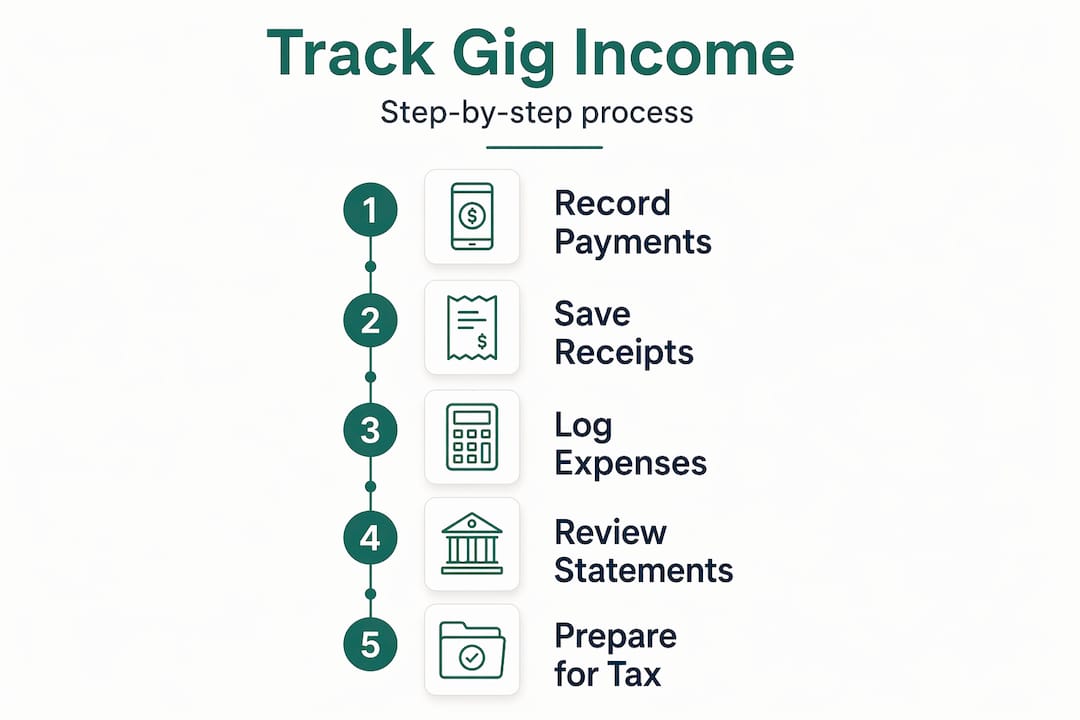
The ATO uses the Sharing Economy Reporting Regime (SERR) to collect income data directly from platforms. Platforms report your earnings to the ATO via SERR, which means undeclared income from even casual gigs is flagged automatically. If your tax return does not match what the platform reported, you will hear from the ATO.
Here is a numbered checklist to file confidently when you have multiple income streams:
- Gather your annual earnings summary from every platform you worked on during the financial year.
- Reconcile each summary against your bank statements to confirm the figures match.
- Total your deductible expenses by category and confirm each one is backed by a receipt or logbook entry.
- Calculate your GST liability for each quarter and confirm your BAS lodgements match your income records.
- Separate your PAYG income and ensure it appears in the correct section of your return, not mixed in with business income.
- Use the Business and professional items schedule for all ABN-based gig income.
- Lodge your return on time. Late lodgement attracts penalties even when no tax is owed.
Audit triggers for gig drivers typically include sudden drops in declared income, large deduction claims without supporting records, and income figures that do not match platform reports. Consistent, well-organised records are your best protection. If every claim is backed by a dated receipt and a logbook entry, an ATO review becomes a formality rather than a crisis.
Critical warning: The ATO matches platform data to your tax return every year. Undeclared income, even from a few casual gigs, is not invisible. Match your claims to the specific activity they relate to, because rideshare and delivery rules differ.
Use tax time preparation tools to pull your records together well before the 31 October deadline. Rushing at the last minute is where errors creep in.
Why smart systems beat last-minute scrambles every time
Here is an uncomfortable truth that most advice articles skip over: the fear most gig drivers feel around the ATO is not really about tax. It is about disorganisation. When your records are scattered across three apps, a shoebox of receipts, and a memory of "I think I earned about $800 that month," the ATO feels terrifying. But when every dollar is logged, every receipt is categorised, and your BAS is estimated in real time, the tax office becomes just another quarterly task.
The drivers who stress the most at tax time are almost always the ones who did the least throughout the year. They spend hours reconstructing records, second-guessing deductions, and worrying about gaps. The drivers who sail through tax time are not necessarily earning more or working with accountants. They just built simple habits early and stuck to them.
Technology makes this dramatically easier than it was even five years ago. AI-powered receipt capture, automated income categorisation, and real-time GST estimates are now accessible to individual drivers, not just businesses with bookkeepers. The expert system tips available today mean you can spend 15 minutes a week on your finances instead of a panicked weekend in July.
The other thing worth saying plainly: manual systems can work, but they demand real discipline. A notebook and a spreadsheet are perfectly ATO-compliant. The problem is that most people do not maintain them consistently under pressure. A well-chosen app removes the friction and makes the right behaviour the easy behaviour. That is the real advantage of using purpose-built tools for gig work.
Make gig income tracking effortless with GST Driver Tracker
Managing income from Uber, Menulog, and other platforms does not have to mean hours of admin every month. The right tool makes compliance feel automatic rather than stressful.
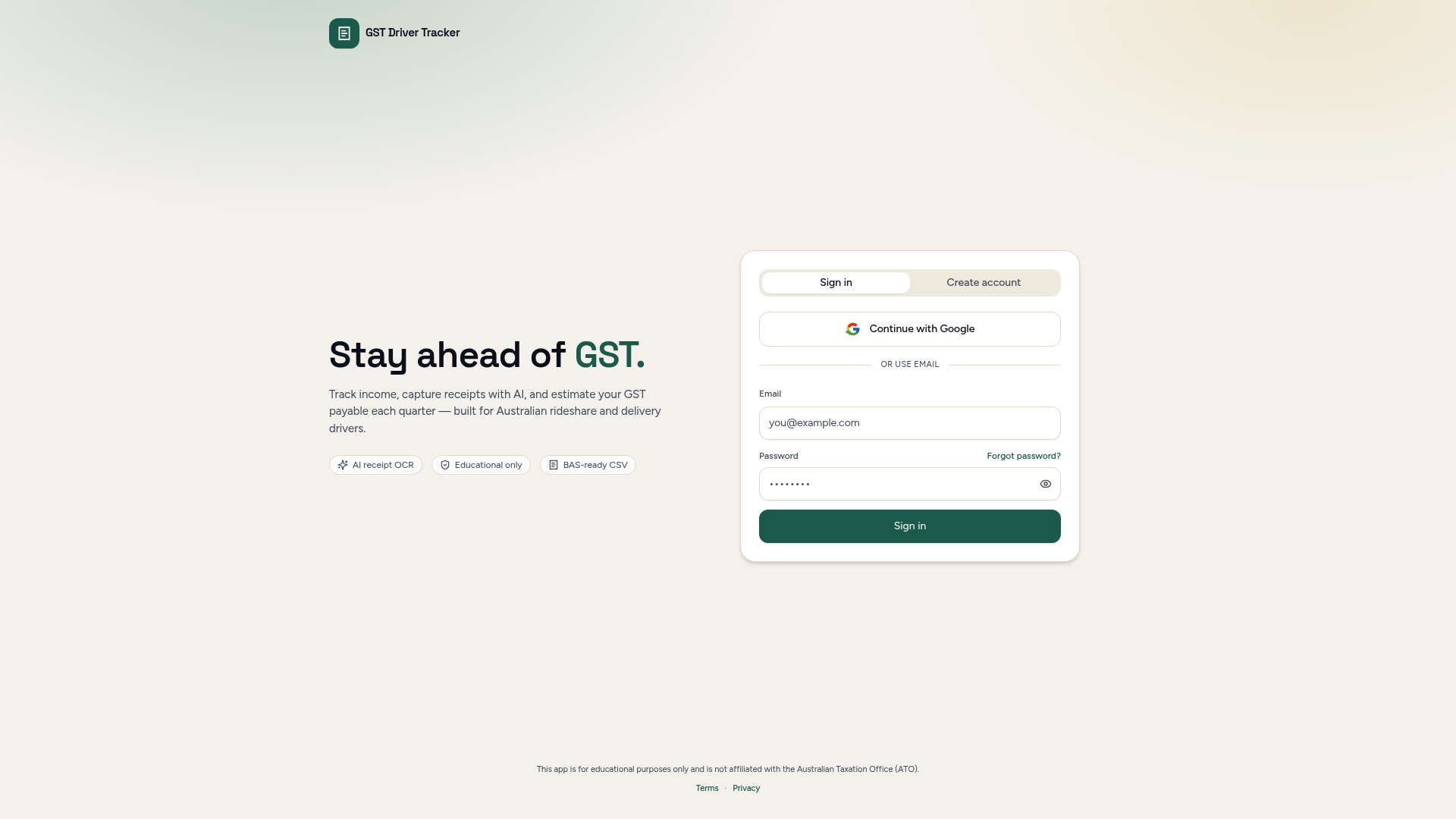
GST Driver Tracker is built specifically for Australian rideshare and delivery drivers who need to stay on top of their BAS, GST estimates, and income records without hiring an accountant. The platform uses AI to capture receipt data, categorises your expenses automatically, and gives you a real-time estimate of your GST liability each quarter. You can export everything in CSV format for your tax agent or lodge with confidence on your own. It is the kind of tool that turns a weekend of tax stress into a 20-minute quarterly review.
Frequently asked questions
Do gig drivers in Australia have to report all platform income on their tax return?
Yes, all gig platform income must be reported as business income, even if the earnings are low or irregular. The ATO requires all gig income reported using the Business and professional items schedule, regardless of the amount earned.
What's the best way to track income and expenses from different gig jobs?
ATO-compliant apps like DRIVR, CarSavvy, or myDeductions make it easier to manage all gig income and expenses in one place. The ATO's myDeductions app specifically supports sole traders with multiple gig activities.
Who needs to register for GST amongst gig drivers?
All rideshare drivers must register for GST and an ABN from day one, while delivery drivers register only if annual turnover exceeds $75,000. The GST registration rules differ based on the type of gig work you perform.
How long do I need to keep my gig work records for tax?
You must keep all records for five years, including platform statements, receipts, logbooks, and bank transaction histories. The ATO's five-year record-keeping rule applies to all business income and expense documentation.
Is the logbook method always better for car expense deductions?
The logbook method usually provides bigger deductions for high-kilometre drivers, but it requires detailed tracking over a 12-week period and must be updated every five years. The logbook versus cents per kilometre comparison favours the logbook method when business use is high and kilometres are significant.