
If you drive for Uber, DoorDash, or any rideshare or delivery platform in Australia, getting your examples of contractor income declarations right is not optional. Unlike most sole traders, rideshare drivers must register for GST from their very first fare, with no $75,000 threshold to hide behind. That means your income declarations directly underpin every BAS you lodge. Get them wrong and you are not just facing a paperwork headache. You are looking at ATO scrutiny, penalties, and potential credit reversals that eat into your earnings.
Table of Contents
- Key criteria for contractor income declarations under GST and BAS
- Examples of income records rideshare drivers should keep
- Common mistakes in contractor income declarations and how to avoid them
- Comparing income declaration methods for rideshare contractors
- How to choose the right income declaration approach for your situation
- Why rideshare drivers must prioritise accurate income declarations to avoid GST audits
- Streamline your GST and BAS compliance with GST Driver Tracker
- Frequently asked questions
Key Takeaways
| Point | Details |
|---|---|
| Keep detailed records | Maintain tax invoices, receipts, and summaries that clearly explain all GST-related transactions for at least five years. |
| Register GST early | You must register for GST from your first rideshare fare even if income is below the standard threshold. |
| Use proper calculations | Report total sales inclusive of GST but compute GST collected only on taxable supplies to avoid BAS errors. |
| Avoid common errors | Do not mix GST-free amounts with taxable income when reporting to the ATO to prevent audits and penalties. |
| Choose a suitable method | Select record-keeping and BAS reporting approaches that match your transaction volume and comfort level for compliance ease. |
Key criteria for contractor income declarations under GST and BAS
Having introduced the importance of compliance, let's explore the formal criteria that govern contractor income declarations for rideshare and delivery drivers.
Your income declarations are not just a summary of what you earned. They are a structured record that the ATO can trace back to individual transactions. Every figure on your BAS must be supported by documentation that explains where it came from.
The ATO requires GST records to be kept for at least five years, and those records must explain every transaction relevant to your GST obligations, including sales amounts, GST collected, dates, and the parties involved. That is a higher bar than many drivers realise.
Here is what your contractor income declarations must include to satisfy GST and BAS requirements:
- Total GST-inclusive income earned across the quarter, broken down by platform if you drive for more than one.
- GST collected on taxable supplies, calculated correctly as one-eleventh of your GST-inclusive fares.
- GST-free income separated out clearly, such as certain delivery services that may attract different treatment.
- Dates of transactions or at minimum the reporting period covered by each summary.
- Identity of the payer, typically the platform name and ABN.
Your GST record keeping must also cover the expense side. Input tax credits (the GST you claim back on business expenses) need the same level of documentation as your income. A receipt without a supplier ABN and GST amount is not a valid tax invoice for claiming purposes.
Key records to maintain include:
- Tax invoices for purchases over $82.50 (GST-inclusive)
- Receipts showing supplier ABN, date, description, and GST amount
- Bank statements reconciling deposits to your declared income
- Platform earnings summaries showing gross fares and service fees
Examples of income records rideshare drivers should keep
With the criteria clear, let's turn to practical examples of the records you need to keep to meet these standards.
The most important document in your contractor earnings documentation is the quarterly Tax Summary provided by your platform. Uber's quarterly Tax Summary shows your total fares including GST, the service fees charged by Uber, and the net amount paid to you. Drivers use these summaries directly for BAS reporting, which makes them the backbone of any self-employed income declaration.
But the Tax Summary alone is not enough. Here is a practical list of the income records every rideshare and delivery driver should maintain:
- Platform Tax Summaries from Uber, Ola, DiDi, DoorDash, or any other platform you use, showing gross fares and GST components
- Bank statements for the quarter, with deposits cross-referenced to your platform payouts
- Fuel receipts with supplier ABN and GST amount clearly shown
- Vehicle maintenance invoices from mechanics or tyre shops, retained as valid tax invoices
- Phone and data receipts if you use your mobile for navigation and platform access (apportioned to business use)
- Tolls and parking receipts incurred during driving shifts
- Vehicle purchase or lease documents if you are claiming depreciation or lease payments
Pro Tip: Download your platform Tax Summary the moment it becomes available each quarter. Do not wait until BAS lodgement time. Platforms occasionally update or correct figures, and having the original plus any revised version protects you if questions arise later.
Using tax summaries effectively means cross-checking the gross fare total against your bank deposits for the same period. If the numbers do not reconcile, investigate before you lodge. A mismatch at BAS time is far less stressful than a mismatch during an audit.
Common mistakes in contractor income declarations and how to avoid them
Armed with knowledge of what to keep, it is important to understand what common errors to watch out for when declaring your income.
One of the most damaging mistakes rideshare drivers make is treating their total platform payout as their taxable income for GST purposes. Your payout is the net figure after Uber or DoorDash deducts their service fee. Your total fares (the gross amount passengers paid) is what you declare as your total sales on your BAS. The service fee is a separate expense you can claim as an input tax credit.

Mixing GST-free amounts into your GST collected calculations is another frequent error that leads to BAS mismatches and overstatements. Some delivery services are GST-free, and lumping them in with your taxable rideshare fares inflates the GST you appear to have collected.
Common mistakes to actively avoid:
- Reporting net payouts instead of gross fares as your total sales figure
- Failing to separate GST-free supplies from standard-rated taxable supplies
- Using vague descriptions like "income" rather than specifying platform, period, and fare type
- Missing the input tax credit on Uber's service fee, which does include GST
- Losing receipts for fuel and maintenance, meaning you cannot claim legitimate deductions
A clean income declaration is one where every BAS line item can be traced back to a specific document within 60 seconds. If you cannot do that, your records need work before you lodge.
Pro Tip: Keep a simple spreadsheet that maps each BAS field to its source document. For example: "G1 Total Sales = Uber Q2 Tax Summary, gross fares column, $8,240." This takes ten minutes per quarter and makes any GST declaration review straightforward.
Comparing income declaration methods for rideshare contractors
Now that we have discussed mistakes to avoid, let's compare common approaches to recording and declaring income to find what works best.
Many drivers lodge quarterly BAS, but the accuracy of that lodgement depends entirely on the bookkeeping method used throughout the quarter. Here is how the main approaches stack up:
| Method | Accuracy | Audit readiness | Time investment | Cost |
|---|---|---|---|---|
| Manual paper records | Low to medium | Poor | High | Nil |
| Spreadsheet tracking | Medium | Moderate | Medium | Nil |
| Platform Tax Summary only | Medium | Moderate | Low | Nil |
| Dedicated tracking app | High | Strong | Low | Low to medium |
The key insight in this comparison is that accuracy and time investment are inversely related only when you use the right tools. Manual paper records take the most time and still produce the weakest audit trail. A dedicated app can take less time than a spreadsheet and produce far more reliable contractor income statement examples for your BAS.
Additional considerations when choosing your method:
- Monthly reconciliation catches errors before they compound across a full quarter
- Digital records are searchable and easier to export if the ATO requests documentation
- Platform summaries alone miss the granular transaction detail that protects you in a dispute
- Combining platform summaries with bank reconciliation gives you two independent verification points
The BAS reporting frequency you choose also matters. Monthly lodgements give you tighter control and earlier visibility of your GST liability, which helps cash flow planning. Quarterly suits most drivers for simplicity, but only if your records are genuinely up to date at quarter end.
How to choose the right income declaration approach for your situation
With a clear comparison of methods, let's conclude with steps to decide which declaration system suits you best.
The right approach depends on three things: how many trips you complete per week, how comfortable you are with financial record-keeping, and how much audit risk you are willing to carry. A driver completing 15 trips a week faces very different record-keeping demands than one doing 60.
Follow these steps to select your income declaration system:
- Count your monthly transactions. If you have more than 80 combined income and expense transactions per month, manual tracking will consume hours you do not have.
- Assess your platform mix. Driving for two or more platforms means reconciling multiple Tax Summaries. A digital tool that aggregates these saves significant time.
- Decide on your BAS lodgement frequency. If you choose quarterly, commit to monthly reconciliation within that quarter so you are not scrambling at deadline time.
- Choose a record format the ATO accepts. Digital records are fine as long as they are legible, complete, and accessible. Blurry phone photos of receipts are not adequate.
- Test your system before your first BAS. Run a mock reconciliation using last quarter's data to confirm your method captures everything correctly.
Pro Tip: The single best habit you can build is a weekly 15-minute record update. Log your platform earnings, photograph any paper receipts, and check your bank statement. Fifteen minutes weekly is far less painful than four hours at BAS time.
Choosing a reliable income declaration system early in your driving career pays dividends. Drivers who establish good habits in their first quarter rarely face the compliance stress that catches others off guard.
Why rideshare drivers must prioritise accurate income declarations to avoid GST audits
Here is the perspective that most compliance guides skip over: accurate income declarations are not primarily about following rules. They are about protecting your income.
When the ATO reviews a BAS, the fastest proof in any dispute is the ability to trace every BAS total back to specific invoices and clear GST calculations. Auditors are not impressed by good intentions. They want a paper trail. If you cannot produce one, the ATO can disallow input tax credits, issue amended assessments, and apply penalties. That money comes directly out of your pocket.
The uncomfortable truth is that many rideshare drivers treat income declarations as an afterthought because the platforms make it seem easy. Uber gives you a Tax Summary. You copy the numbers into your BAS. Done. Except it is not done, because that approach ignores the expense side, misses GST-free supply distinctions, and leaves you with no independent verification if the platform's figures are ever questioned.
Professional record-keeping is not a burden reserved for accountants. It is a skill that pays for itself the first time you face a query from the ATO and can answer it in minutes rather than days. Drivers who invest in proper contractor earnings documentation sleep better and keep more of what they earn.
Technology has removed most of the friction. An app that captures receipts with AI, estimates your quarterly GST liability, and exports your records in a format the ATO recognises is not a luxury. For anyone driving more than a few shifts a week, it is the sensible baseline. The audit preparation advantage that comes from organised digital records is real and measurable.
Streamline your GST and BAS compliance with GST Driver Tracker
Managing your contractor income declarations does not have to consume your evenings or cause end-of-quarter panic. GST Driver Tracker is built specifically for Australian rideshare and delivery drivers who want to stay on top of their GST and BAS obligations without becoming amateur accountants.
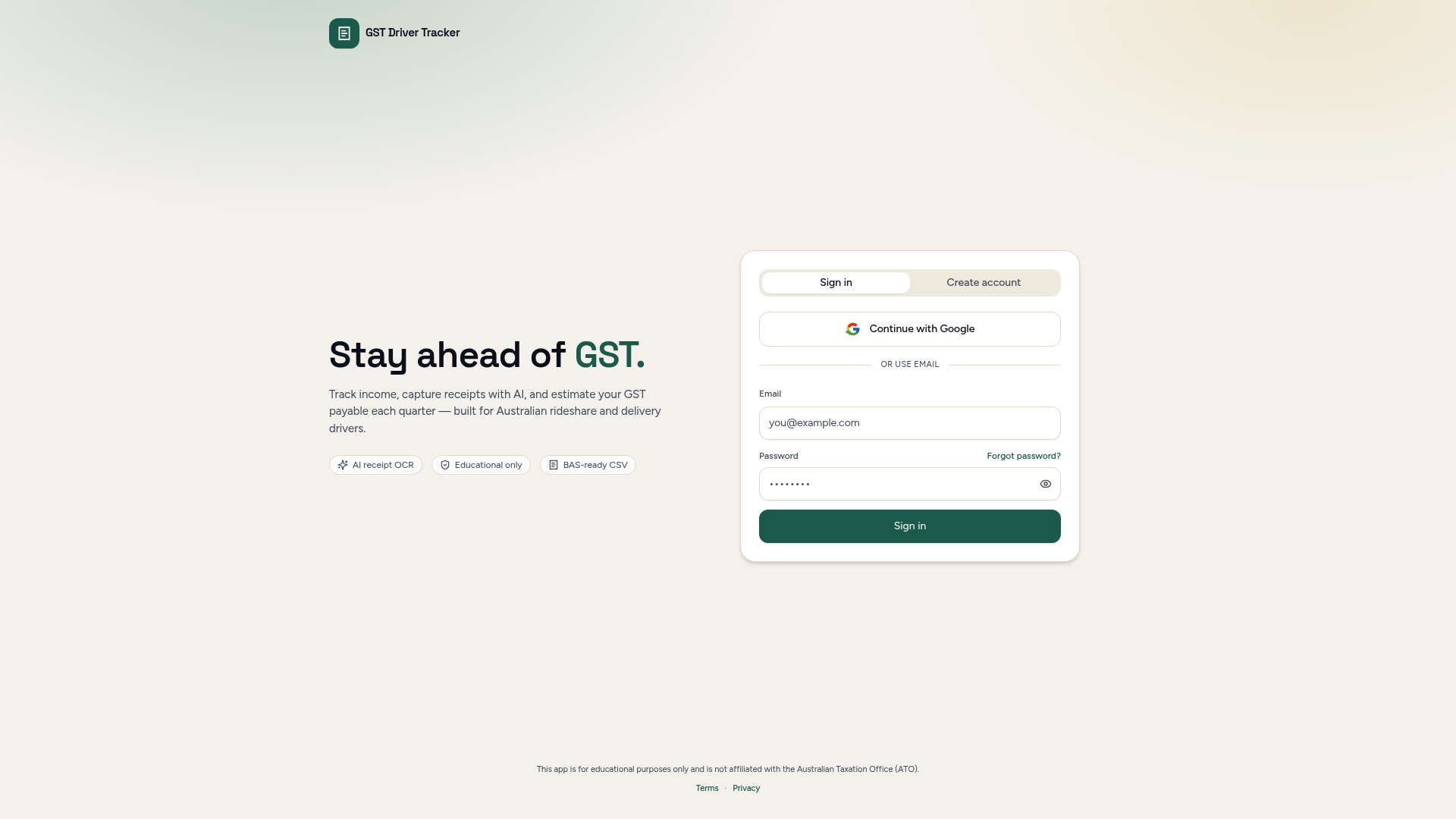
GST Driver Tracker lets you track your income and expenses in one place, capture receipt data using AI technology, and estimate your GST payable for each quarter before you lodge. The platform organises your records into the categories the ATO expects, exports data as CSV for your tax agent, and gives you educational resources to understand exactly what you are declaring and why. It is the practical tool that turns compliance from a quarterly scramble into a five-minute weekly habit.
Frequently asked questions
What records must I keep to declare my income correctly as a rideshare driver?
You should keep tax invoices, receipts, bank statements, and digital platform summaries that detail your fares, service fees, and GST amounts. The ATO requires five-year retention of all records explaining transactions relevant to your GST obligations.
Do I need to register for GST from my first ride?
Yes. Australian rideshare drivers must register for GST from their first fare, with no $75,000 threshold applying to this category of work, unlike most other sole traders.
How often must I lodge my BAS as a GST-registered rideshare contractor?
Most rideshare contractors lodge quarterly BAS, but monthly lodgements are available and can improve record accuracy and cash flow visibility for higher-volume drivers.
What common mistakes should I avoid when declaring contractor income?
Avoid reporting your net platform payout instead of gross fares as your total sales, and never mix GST-free amounts into your GST collected calculation, as this causes BAS mismatches and can trigger ATO review.